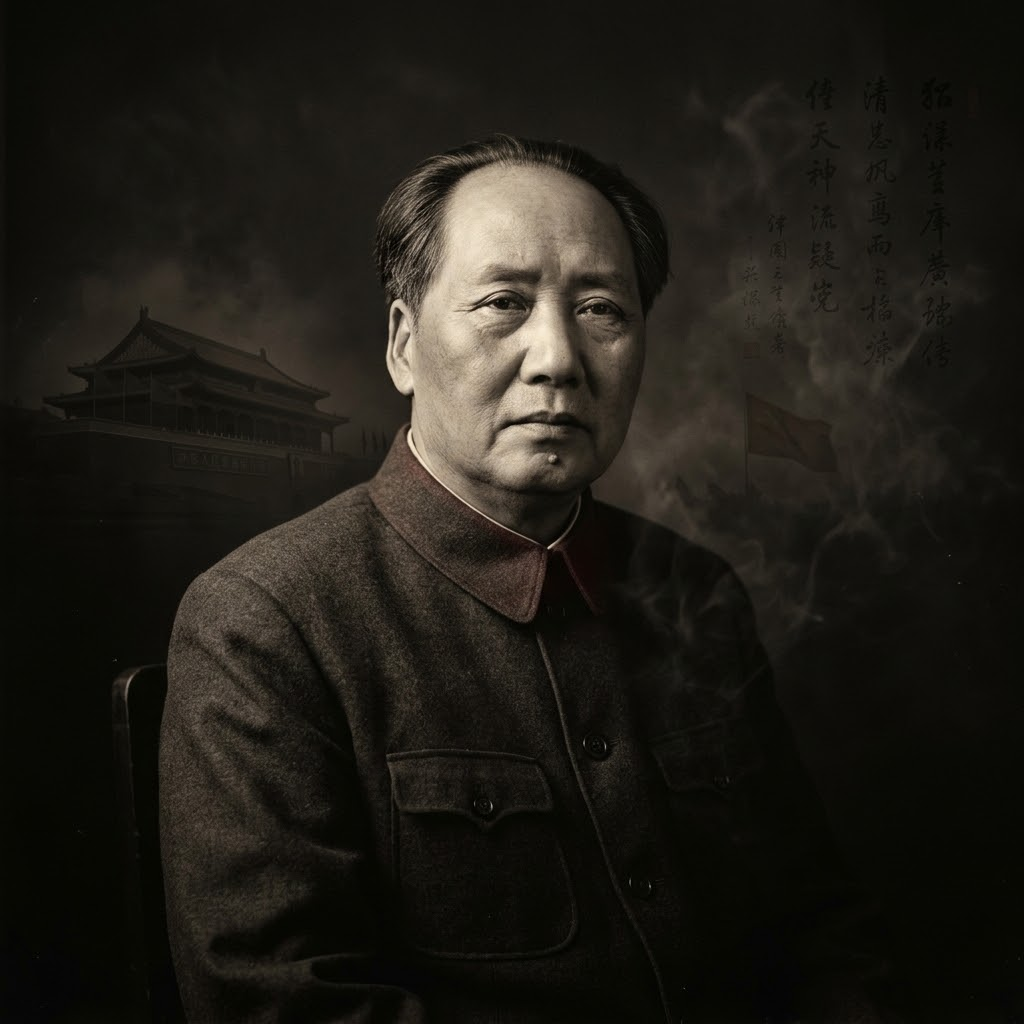
Reunified China after a century of fragmentation and foreign humiliation, establishing the People's Republic of China, while orchestrating radical utopian campaigns that resulted in catastrophic famine and social fracture.
- Years as Supreme Leader
- 27
- Cadres at 1962 Confession
- 7,000
- Years Kept Son's Relics Secret
- 26
- Official Legacy Verdict
- 70 / 30
The Architect of the Tempest
The Locked Chest of Zhongnanhai
In the quiet gloom of Building 202 inside the Zhongnanhai compound, amidst towering barricades of thread-bound dynastic histories, Mao Zedong spent his final years enveloped by an impenetrable silence. Outside, hundreds of millions chanted his name and carried his Little Red Book like sacred scripture. Yet inside his shuttered chambers, the paramount leader was haunted by an unbearable private sorrow. At the bottom of his wardrobe stood a plain, locked wooden chest that accompanied him through every relocation since 1950. Only after his death was it opened: inside lay no secret state directives, but the carefully folded cotton checkered shirt, military winter cap, towel, and mended wool socks of his eldest son, Mao Anying, who was killed by napalm in the Korean War. For twenty-six years, the man who demanded that an entire civilization surrender its familial loyalties to the collective had secretly wept over the relics of his own flesh and blood.
The Hubris of the Furnace
Mao’s greatest public tragedy was born not of malice, but of an unyielding, hubristic conviction that human willpower could conquer material reality. In 1958, impatient with conventional economics, he launched the Great Leap Forward. Peasant communes were ordered to melt agricultural tools in primitive backyard furnaces to surpass the industrial output of the West, while false reports of miraculous grain yields flooded Beijing. The resulting reality was the Great Chinese Famine, a human disaster of unfathomable magnitude. In January 1962, confronting seven thousand party cadres assembled in the Great Hall of the People, the supreme leader was forced to stand before the ledger of truth. "The primary person responsible must be me," he conceded. It was the only time he bowed his head to collective culpability—a bitter humiliation that convinced him his revolutionary comrades were losing their ideological faith.
The Tempest Unleashed
Terrified that his revolution would settle into bourgeois complacency, Mao unleashed the Cultural Revolution in 1966, summoning the nation’s youth to "bombard the headquarters." But the ideological firestorm quickly consumed its own masters. Street battles, factional purges, and the destruction of millenniums-old cultural treasures tore the social fabric apart. When student factions turned lethal in 1968, Mao summoned their leaders and wept, exclaiming that the "black hand" driving the chaos was none other than himself. The deepest psychological rupture arrived in September 1971, when his designated successor and "closest comrade-in-arms," Marshal Lin Biao, fled following an abortive coup and perished in a plane crash. Mao never recovered from the betrayal; his health collapsed overnight into insomnia, heart failure, and advancing paralysis.
The Withered Tree
In his twilight months, unable to walk, partially blind, and struggling for breath, the titan of Chinese communism spent his days listening to attendants read the ancient *Rhapsody on the Withered Tree*. Tears streamed down his cheeks as he memorized the verses: *"In bygone years I planted willows... today I watch their leaves fall, desolate beside the river. If even a tree is like this, how can a man endure!"* In his final testament to the Politburo standing committee, he confessed the bitter truth of his life’s work: he had driven Chiang Kai-shek into exile and defeated foreign empires, but his final crusade, the Cultural Revolution, had few supporters and many enemies. "If this legacy cannot be handed down in peace," he warned in frail whispers, "it will be passed in turmoil, amidst winds of blood." The Great Helmsman departed, leaving behind a nation exhausted by his storms and a heart locked within a chest of silent grief.
Biography
Mao Zedong (1893–1976) was the founding father of the People's Republic of China and Chairman of the Chinese Communist Party from 1945 until his death.
Key Events
1935
Ascent at Zunyi
Takes effective military leadership during the Long March, establishing paramount authority over the party.
1949
Proclamation of the PRC
Declares the founding of the People's Republic of China atop Tiananmen Gate, ending decades of civil war.
1950
Loss of Mao Anying
His eldest son is killed in the Korean War; Mao conceals his grief and secretly preserves his son's relics for 26 years.
1958–1962
The Great Leap Forward
Forced industrialization causes the Great Famine, leading to his unprecedented 1962 public self-criticism.
1966–1971
Cultural Revolution & Lin Biao
Unleashes the Red Guards to purge institutions; the betrayal and death of successor Lin Biao shatters his spirit.
1976
Twilight and Death
Paralyzed and isolated in Zhongnanhai, he passes away at 82, warning of turmoil and factional bloodletting.
Major Projects
The Great Leap Forward (1958–1962): A radical mobilization campaign to industrialize agrarian China, precipitating widespread economic collapse and the Great Chinese Famine.
The Cultural Revolution (1966–1976): A decade-long sociopolitical movement to purge capitalist and traditional elements, fracturing Chinese society.
The Long March (1934–1935): A legendary 6,000-mile tactical military retreat that cemented Mao's supreme authority over the Communist Party.
Sino-American Opening (1972): Orchestrated the historic meeting with Richard Nixon, fundamentally reshaping Cold War geopolitics.
Distinctions
The Great Helmsman: Paramount revolutionary honorific during the mid-20th century.
Chairman of the Central Committee: Supreme leadership title held uninterrupted from 1945 to 1976.
Legacy
A monumental and deeply contradictory figure who ended a century of foreign domination and rebuilt a unified nation, but whose utopian socioeconomic experiments inflicted immense human suffering. Modern history views him through the sobering lens of absolute power and the tragic consequences of unrestrained ideological zeal.
The End
Died at 00:10 AM on September 9, 1976, at the age of 82, in Building 202 inside Zhongnanhai, Beijing, succumbing to amyotrophic lateral sclerosis (ALS) and congestive heart failure.