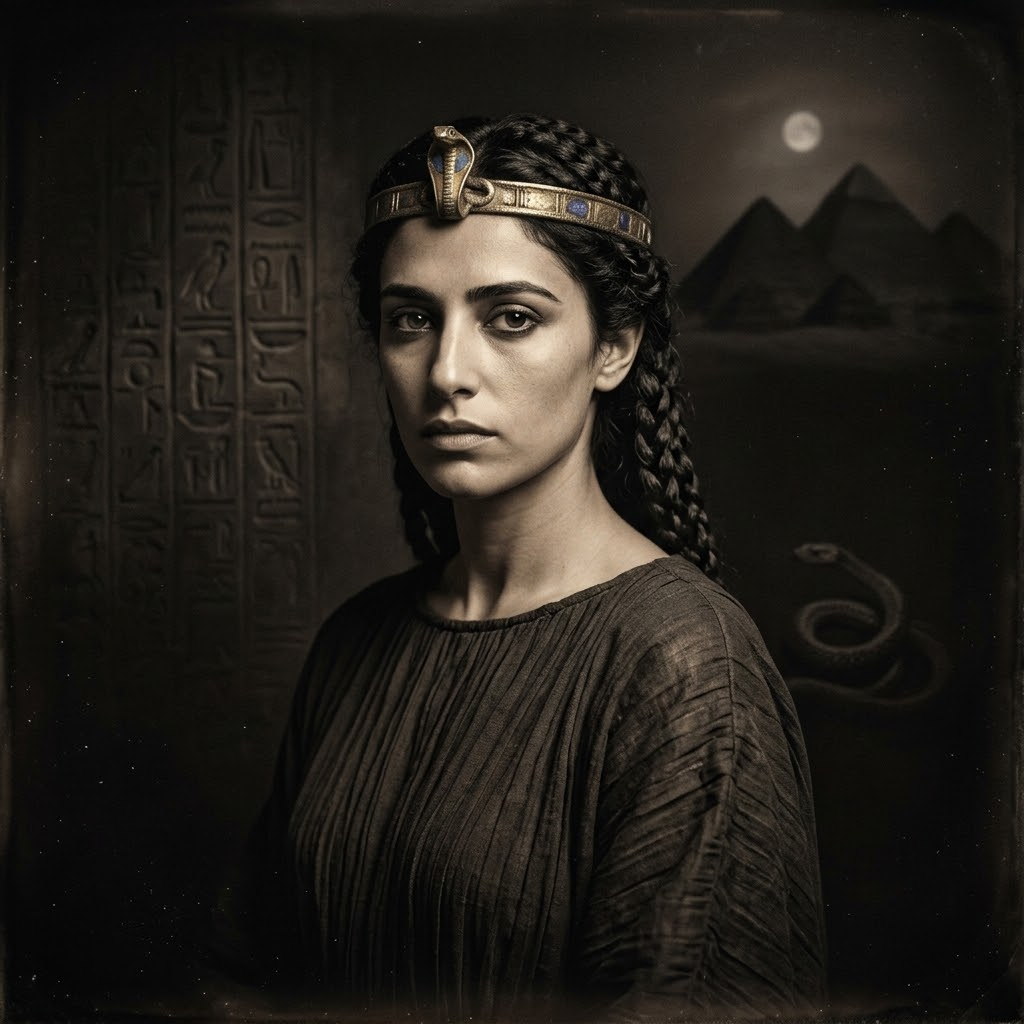
The last active ruler of the Ptolemaic Kingdom of Egypt. Her political alliances and romantic liaisons with Julius Caesar and Mark Antony were desperate attempts to save her kingdom from Roman annexation.
- Reign
- 21 Years
- Pharaoh of Egypt
- Last
- Languages Spoken
- 9
- Chosen End
- Asp
The Serpent's Kiss
In the flickering lamplight of an Alexandria palace, a woman of extraordinary intellect and unmatched ambition watched the shadows of Rome lengthen across her beloved Nile. Cleopatra VII was not the mere seductress that Roman propaganda later painted; she was a brilliant polyglot, a savvy economist, and the last true shield of an independent Egypt. Her regret was not born of love, but of the realization that even the most brilliant mind cannot hold back the tide of an empire destined to consume the world.
The Gamble for an Empire
Cleopatra’s reign was a high-stakes game of survival. Understanding that Egypt could not withstand Rome’s military might, she sought to bind her kingdom’s fate to Rome’s most powerful leaders. She captivated Julius Caesar, not just with her charm, but with her vision of a Mediterranean empire where Alexandria and Rome stood as equals. Together, they forged an alliance that promised to secure her throne and her son’s future. But the daggers of the Ides of March shattered that dream, leaving her alone in a sea of rising Roman hostility.
The Alliance of Desperation
When Mark Antony arrived, Cleopatra saw a second chance - and perhaps a deeper connection. Their partnership was a whirlwind of luxury and shared ambition, a "Society of Inimitable Livers" that defied the austere demands of Octavian’s Rome. For her, every banquet and every political gesture was a calculated move to preserve the Ptolemaic legacy. But love and politics became dangerously intertwined, and the disastrous defeat at the Battle of Actium signaled the end of her world.
The Final Defiance
As Octavian’s legions closed in on Alexandria, Cleopatra found herself trapped in her own high-walled mausoleum. The man she had gambled everything on, Antony, lay dead by his own hand. Octavian planned to parade her through the streets of Rome in golden chains - a final humiliation she would never permit. Her ultimate regret was the cold, hard certainty that her brilliance had only delayed the inevitable. She had outplayed every opponent except history itself.
The Goddess Departs
Choice became her final act of sovereignty. Preferring the bite of an asp to the chains of a conqueror, she sought a death that preserved her dignity as a living goddess. Cleopatra died as she had lived - on her own terms - but the weight of her regret lingered in the silence of the palace. She left behind a fallen kingdom and children whose futures she could no longer protect, a tragic reminder that power, however great, is often just a stay of execution against the relentless march of time.
Biography
Cleopatra VII Philopator (69-30 BC) was the last active Pharoah of Ancient Egypt. She was a member of the Ptolemaic dynasty, a family of Greek origin that ruled Egypt after Alexander the Great's death.
Key Events
-69
Birth
Born in Alexandria, Egypt.
-51
Ascension
Becomes joint ruler with her brother Ptolemy XIII.
-48
Caesar
Forms an alliance with Julius Caesar.
-41
Antony
Begins her famous relationship with Mark Antony.
-31
Actium
Defeat at the Battle of Actium.
-30
Death
Commits suicide to avoid Roman captivity.
Major Projects
The Library of Alexandria: She was a scholar who frequented the great library.
The Caesareum: A temple she began constructing for Julius Caesar.
Distinctions
Goddess Incarnate: Worshipped as the living Isis.
Legacy
Her name became synonymous with dangerous beauty and power. She remains one of the most famous women in history.
The End
Died on August 12, 30 BC, famously by allowing an asp (cobra) to bite her, denying Rome the satisfaction of executing her.