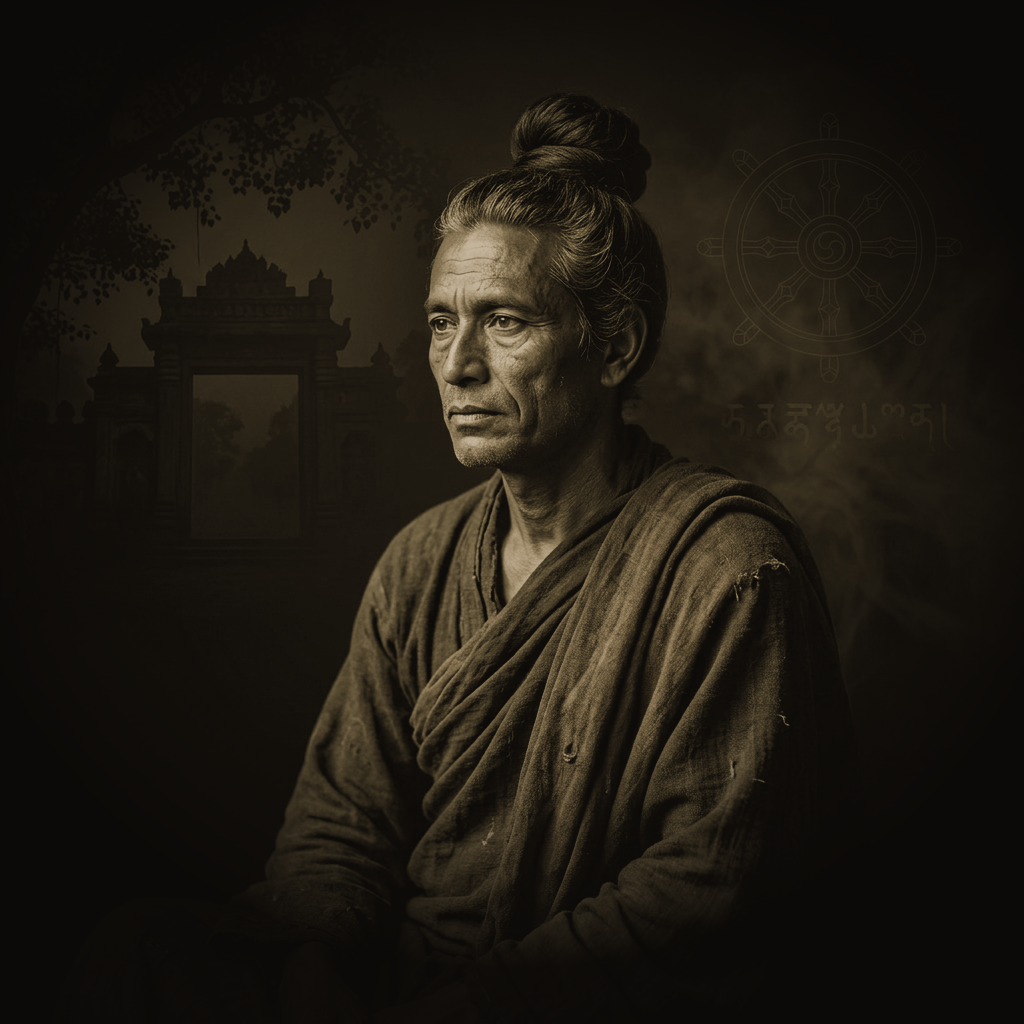
Renounced his royal heritage in ancient Kapilavastu to found Buddhism, reshaping the spiritual and ethical landscape of Asia and the world across twenty-five centuries.
- Age at Midnight Departure
- 29
- Blocked Army Under Dead Tree
- 3x
- Years Walking as a Mendicant
- 45
- Age at Final Passing
- 80
The Prince Who Named His Son a Fetter
The Threshold at Midnight
Before the world cast his likeness in bronze and gold, Siddhartha Gautama was a twenty-nine-year-old prince standing barefoot at the threshold of a dim bedchamber in Kapilavastu. Inside, beneath scented oil lamps, his wife Princess Yasodhara lay exhausted from childbirth, her arm draped protectively over their newborn son. When word of the birth had reached Siddhartha hours earlier, a quiet dread had risen in his throat: *"Rahula has been born; a fetter has arisen."* To free humanity from the wheel of aging, sickness, and death, he believed he had to sever every mortal attachment. He did not wake Yasodhara to touch her hand or speak a word of parting, fearing that if he held his child even once, he would never find the strength to leave. He turned his back and rode into the dark forest, leaving a woman to wake to an empty palace and a boy whose very name meant "obstacle."
The Begging Bowl in His Father's Street
Seven years later, after nearly starving himself to death and finally attaining awakening beneath the Bodhi tree at Uruvela, Siddhartha returned to Kapilavastu not as an heir, but as a shaven-headed mendicant in coarse saffron rags. As he walked slowly from door to door with an alms bowl in the capital of his ancestors, his aged father, King Suddhodana, rushed into the street with tears streaming down his weathered cheeks. *"Why do you disgrace our royal house by begging where you once rode in chariots?"* the king pleaded. Inside the palace, Yasodhara fell at Siddhartha's feet, weeping until her hair soaked his ankles. When seven-year-old Rahula was sent out by his mother to ask the stranger for his royal inheritance, Siddhartha did not give him gold or land; he handed the child a monk's robe and ordained him into homelessness, extinguishing his father's dynastic line forever.
Beneath the Leafless Tree
Even supreme detachment could not shield Siddhartha from the final, devastating reckoning of his mortal ties. In his twilight years, King Vidudabha of Kosala marched a massive army toward Kapilavastu, driven by an ancient blood feud to exterminate the Shakya clan. The eighty-year-old Buddha walked alone into the blistering sun and sat silently beneath a dead, leafless tree on the border road. When Vidudabha asked why the sage sat beneath a withered trunk instead of the lush banyan trees nearby, Siddhartha answered quietly: *"The shade of one's kinsmen is the coolest of all."* Out of reverence, the king turned his army back twice. Yet when Vidudabha marched a fourth time, Siddhartha looked into the long chain of historical cause and effect and saw that the bloodshed could no longer be held back. He did not return to the road.
The Ash of Kapilavastu
Vidudabha's soldiers razed Kapilavastu to the ground and slaughtered the Shakyas without mercy, sparing neither elders nor infants. According to the ancient chronicles, as smoke rose over his homeland, the awakened master was struck by a blinding headache - the physical echo of watching his own people perish while knowing that even enlightenment could not rewrite the laws of human violence. Months later, frail and poisoned by a spoiled meal offered by the blacksmith Cunda, Siddhartha lay dying on his right side between twin Sal trees in Kushinagar. He had given humanity a path beyond sorrow, yet the price of that path remained etched in the ruins of Kapilavastu and the silent doorway he had walked away from fifty-one years before.
Biography
Siddhartha Gautama (c. 563-483 BCE), known as Shakyamuni or the Buddha, was a Shakya prince, ascetic philosopher, and spiritual teacher of ancient India.
Key Events
c. 563 BCE
Birth in Lumbini
Born into the ruling warrior nobility of the Shakya republic; his mother Queen Maya dies seven days later.
c. 534 BCE
The Midnight Renunciation
Names his newborn son Rahula ("Fetter") and secretly leaves his sleeping wife Yasodhara in the dead of night.
c. 528 BCE
Awakening at Bodh Gaya
After six years of extreme asceticism, attains enlightenment beneath the Bodhi tree and begins teaching at Sarnath.
c. 527 BCE
Return to Kapilavastu
Returns as a mendicant monk; ordains his seven-year-old son Rahula instead of granting him the royal throne.
c. 484 BCE
Massacre of the Shakyas
Sits three times beneath a leafless tree to halt King Vidudabha's army before Kapilavastu is ultimately destroyed.
c. 483 BCE
Death at Kushinagar
Passes away at age 80 between twin Sal trees, reminding his followers that all compounded things decay.
Major Projects
The Middle Way (Majjhima Patipada): Formulated an ethical and meditative path rejecting both royal indulgence and extreme self-mortification.
The Monastic Sangha: Established one of the oldest continuously operating egalitarian monastic communities in human history.
The Four Noble Truths: Articulated a psychological and philosophical framework examining the nature, origin, and cessation of human suffering.
Distinctions
Shakyamuni (Sage of the Shakyas): Revered across Asia as the historical founder of Buddhist philosophy.
Tathagata: Honorific title denoting one who has seen reality as it truly is.
Legacy
Remembered across millennia as the serene teacher of compassion and non-attachment, yet his historical biography preserves the profound human cost of renunciation: a deserted family, a shattered royal lineage, and an annihilated homeland.
The End
Passed away around 483 BCE at the age of 80 between twin Sal trees in Kushinagar (modern Uttar Pradesh, India) from severe mesenteric illness following a final meal.