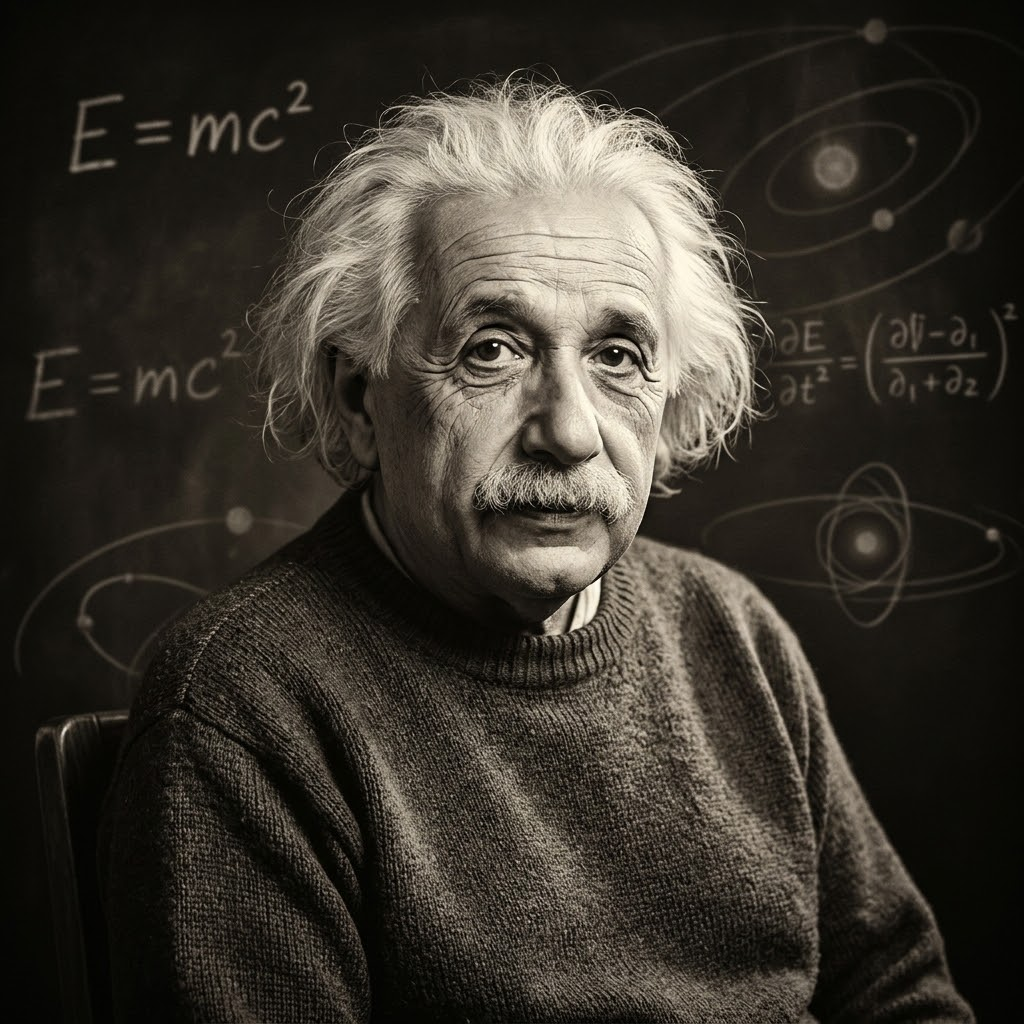
His letter to President Roosevelt initiated the Manhattan Project, fundamentally altering the course of human history and ushering in the nuclear age - a power he spent his remaining days trying to restrain.
- Nobel Prize
- 1
- Scientific Papers
- 300+
- Most Famous Equation
- E=mc²
- Emigrated to USA
- 1933
The Ghost of Hiroshima
In the quiet, leafy streets of Princeton, an old man with wild white hair and no socks would often walk in deep contemplation. To the public, he was the living symbol of human genius. But in the private corridors of his mind, he was haunted by the weight of a single pen stroke. Albert Einstein’s greatest regret wasn't a mathematical error or a failed theory, but a choice born of absolute terror.
The Letter of Fate
In the sweltering summer of 1939, as the shadows of the Third Reich began to stretch across Europe, Einstein made a fateful decision. Encouraged by fellow physicists Leo Szilard and Eugene Wigner, he signed a letter to President Franklin D. Roosevelt. It was a warning that Nazi Germany might be on the verge of weaponizing the atom, uncovering a power locked within the very fabric of matter - a power Einstein himself had defined with E=mc². The plea was for the United States to accelerate its own nuclear research before the abyss claimed the world. This signature became the catalyst for the Manhattan Project.
The Scientist's Paradox
Ironically, Einstein never worked on the bomb himself; the very government he warned denied him security clearance, citing his pacifist leanings and "radical" political associations. Yet, when the news broke of the devastation at Hiroshima and Nagasaki in 1945, he felt the burden of every life extinguished in a flash of artificial suns. "Woe is me," he reportedly whispered to his secretary. The man who had spent his life seeking the elegant harmony of the universe had inadvertently provided the key to its potential destruction. He saw his equations, once meant to explain the stars, used to incinerate cities.
A Crusade for Disarmament
His final decade was a relentless campaign to correct course. He became a tireless advocate for global peace, nuclear disarmament, and the establishment of a world government to manage the terrors he helped awaken. He famously called his letter to Roosevelt the "one great mistake" of his life. Working feverishly with Bertrand Russell, he authored the Russell-Einstein Manifesto, highlighting the existential threat atomic weapons posed to humanity's survival. He realized that the light he had helped bring into the world had cast a shadow that could never be fully erased.
The Unfinished Theory
Einstein passed away with a pen in his hand, still searching for a unified field theory that would reconcile the fundamental forces of nature. He left behind a world living under the permanent shadow of his "great mistake," a reminder that even the most brilliant discoveries can have consequences that haunt their creators until their final breath. He died not just as a scientist, but as a remorseful guardian of a fire he never intended to be used for ash.
Biography
Albert Einstein (1879-1955) was a German-born theoretical physicist whose work reshaped our understanding of the universe. He developed the theories of special and general relativity and contributed significantly to quantum mechanics. Settling in the United States after fleeing Nazi Germany, he became a global icon of intellectual depth, scientific genius, and humanitarian advocacy.
Key Events
1879
Birth
Born in Ulm, in the Kingdom of Württemberg in the German Empire.
1905
Annus Mirabilis
Published four groundbreaking papers, including the special theory of relativity and E=mc².
1921
Nobel Prize
Recognized globally for his contributions to theoretical physics.
1939
The Letter
Signed the letter to FDR, an act he later called his greatest mistake.
1955
Final Thought
Passed away in Princeton, working on a unified field theory until the very end.
Major Projects
General Relativity (1915): A revolutionary theory of gravitation that describes the fabric of space-time.
The Einstein-Szilard Letter (1939): The historical document that alerted the U.S. to the possibility of atomic weapons and changed the world forever.
Unified Field Theory: His lifelong, uncompleted quest to reconcile the fundamental forces of nature into a single elegant equation.
Distinctions
Nobel Prize in Physics (1921): Awarded for his discovery of the law of the photoelectric effect.
Copley Medal (1925): The highest award of the Royal Society for his work on relativity.
Legacy
Einstein is synonymous with 'genius'. His scientific contributions are the bedrock of modern physics, from GPS technology to our understanding of black holes. Beyond science, his legacy is one of unwavering pacifism and the courageous pursuit of truth in a time of global madness.
The End
Died on April 18, 1955, in Princeton, New Jersey, after suffering an abdominal aortic aneurysm. He refused surgery, saying: 'I want to go when I want. It is tasteless to prolong life artificially.'